
6. Public 44net DTN node, Satellites, and the RADIANT Project
This is the sixth and final post in a series exploring Delay-Tolerant Networking (DTN) and resilient communication stacks built for amateur radio, space payloads, and emergency networks.
Expanding from local tests to global mesh
I wanted to test delay-tolerant networks in my daily life, moving past offline loopback simulations and phone-to-phone tests. So I setup a persistent backbone infrastructure that peers can connect to, exchange bundles, and fetch asynchronous resources.
To address this, I have deployed a public instance of the Hardy BPA server on the amateur radio IP network (AMPRNet / 44net).
The Network Architecture
My current testing infrastructure bridges mobile field clients with local desktop machines through this public backbone node.
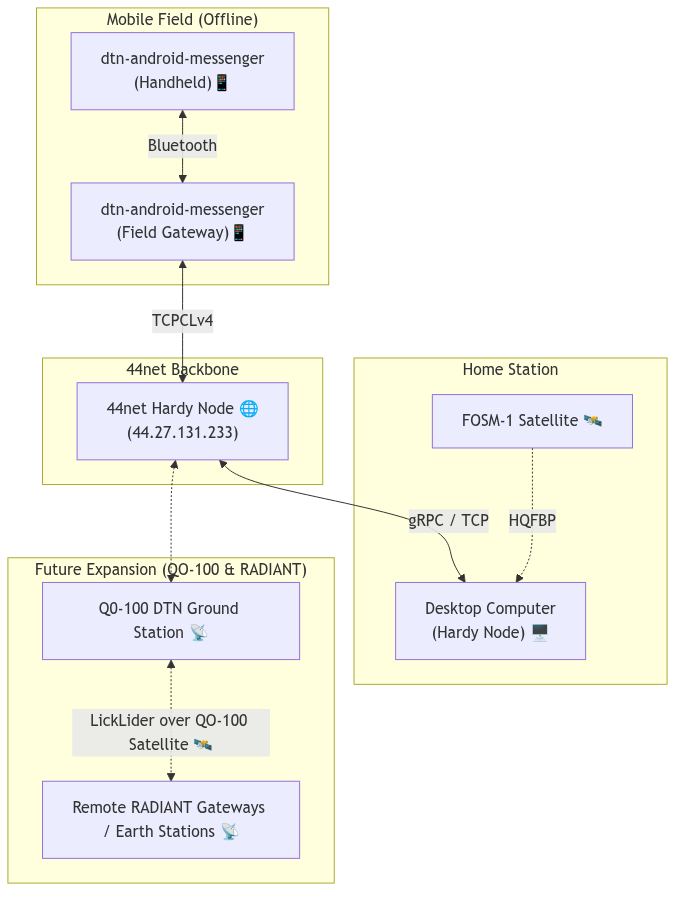
In this model:
- Field operators use
dtn-android-messengerto chat, share files, and collect SenML weather telemetry. - Devices synchronize opportunistically via Bluetooth.
- Once a gateway node gets connectivity to the 44net backbone via Internet IP address, it connects to the public Hardy node at
44.27.131.233using the TCPCLv4 convergence layer. - The public node acts as a persistent mailbox, routing bundles back to home stations or local desktop setups.
Peering Configuration
Note: Hardy uses YAML for its server configuration, alongside a custom line-by-line configuration for static routing rules.
To peer your local Hardy node with the public gateway, add the connection under the clas section of your configuration file:
# In /etc/hardy/my-config.yaml
clas:
  - name: tcpcl-44net-gateway
    type: tcpclv4
    address: "[::]:4556" # local listening port
    require-tls: false   # disabled for amateur radio compliance in case one connect over hamnet
    peers:
      - "44.27.131.233:4556" # outbound connection to my public node
Then, configure a static route rule to send any bundle matching a destination EID pattern through the gateway:
# In /etc/hardy/static_routes
# Route all dtn:// traffic via my 44net gateway EID
dtn://*/** via dtn://f4jxq/
To check that it is properly configured, you can either try a ping to dtn://f4jxq/echo
or requests some statistics to see who else is using it by sending anything to dtn://f4jxq/stats.
You will receive back a log.
If you are using it, please, send me a simple text message to dtn://f4jxq/chat.
The Next Step: QO-100 and the RADIANT Project
While internet-backed tunnels on 44net are excellent for testing the network layer, the ultimate goal of amateur radio is autonomous RF routing.
Thanks to the RADIANT project (sponsored by AMSAT-UK, AMSAT-DL, Goonhilly Earth Station), as they are working to extend this DTN infrastructure to satellite links. The geostationary satellite QO-100 (Qatar-OSCAR 100) provides a continuous amateur radio transponder spanning Europe, Africa, and parts of Asia. I am currently QRV for SSB voice, I still need a bit of work to transmit data on it.
So tomorrow, instead of relying on terrestrial routes:
- I will broadcast DTN bundles over HQFBP from my FOSM-1 satellite payload.
- I will exchange DTN bundles via LickLider protocol directly up to QO-100.
- This will form a earth-based, low orbit, and geostationnary orbit delay-tolerant mesh network, providing delay/disruption tolerant network connectivity to remote stations.
Conclusion
Over this six-part series, I have built a complete, open-source, delay-tolerant stack for the ham radio operator:
- Link Layer: Optimizing file transfers with HQFBP and simulating bit error rates.
- Network Layer: Running the high-performance Rust Hardy BPA daemon.
- CLI Utilities: Automating actions on incoming bundles with
dtntriggeranddtn-hdy-utils. - Mobile Clients: Taking DTN into the field with a native Kotlin Android Messenger featuring SenML telemetry dashboard.
- Application Protocol: Requesting resources asynchronously with the Basket Protocol.
- Community Deployment: Peering over 44net and look ahead to satellite missions.
The code is open, the public gateway is live, and the mesh is waiting for your packets. 73!